Your next customer probably will not find you on Google. They will find you on TikTok, Instagram, YouTube, or Facebook. Or they will find your competitor there instead. Social media is the new search engine, and the numbers back it up. Nearly one in three consumers now skip Google entirely and start their search on social platforms. For Gen Z, that number climbs past 50 percent. Google itself has estimated that around 40 percent of young people turn to TikTok or Instagram when looking for a place to eat, not Google Search or Maps. Every platform your customers scroll is now a social media search engine, and that changes how businesses need to think about visibility. Traditional SEO still matters. But if your social profiles are not optimized to rank in search, you are invisible to a growing share of your market.
In this Moksh Digital blog, you will get to know how to rank on the four platforms that matter most: TikTok, Instagram, YouTube, and Facebook.
Why Social Search Should Be on Your Radar
People do not just scroll social media anymore. They search it. They type “best dentist near me” into TikTok. They search “how to fix a leaky faucet” on YouTube. They look up “wedding photographer Chicago” on Instagram. And they check Facebook reviews before walking into a local business.
The behavior shift is measurable. About two-thirds of US consumers have used social search. And Google now indexes public Instagram posts and short-form videos in its results, which means your social content can rank on Google too.
Social search has gone multi-modal this year. People are no longer just typing keywords into a search bar. They are searching with their voice, snapping photos to find products, and asking full questions the way they would ask ChatGPT. Hootsuite’s 2026 trends research confirms that visual and voice search are making social discovery more conversational. The takeaway for your business: content optimized for natural, question-style phrases now beats content stuffed with exact-match keywords.
The search bar on TikTok and Instagram is no longer a nice-to-have feature. For a growing share of buyers, it is the front door to your business.
Social Search vs Traditional SEO: What Changed
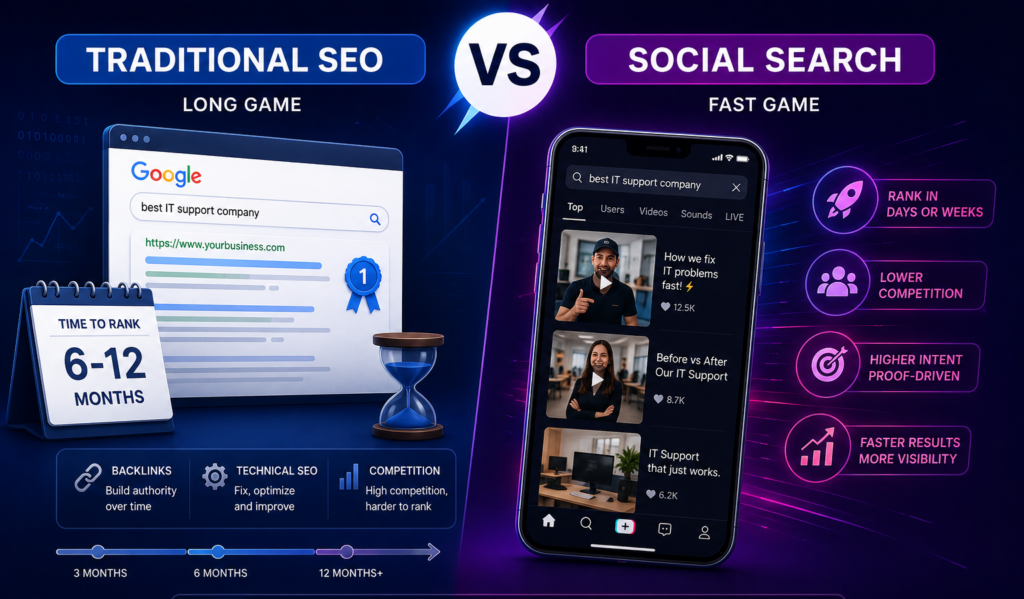
Traditional SEO is a long game. Ranking on page one of Google can take a year of consistent work, backlinks, and technical fixes. Social search moves faster. Ranking for a niche search on TikTok or Instagram can happen in weeks because the competition is thinner. Most businesses treat social media marketing as posting and hoping, and have not optimized their content for search at all. The intent is different too. Google searchers want answers. Social searchers want proof. They want to see the result, the before-and-after, the real person behind the business. That is why social media marketing built for search needs to show, not just tell. Businesses that move now get a head start their competitors will struggle to close.
How to Rank on TikTok
TikTok is the platform where search behavior has changed fastest. Users treat the search bar like Google, and TikTok rewards content that matches search intent.
1. Say Your Keyword in the First Three Seconds
TikTok transcribes your audio and uses it to categorize your video. If your video answers “how much do dental implants cost,” say that phrase early.
2. Put Keywords in Your On-Screen Text
TikTok reads the text on your video. Use it to reinforce what the video covers.
3. Write Keyword-Rich Captions
Captions allow up to 4,000 characters. Use the space. Describe your video the way a customer would search for it.
4. Choose Search-Friendly Hashtags, Not Viral Ones
#SmallBusinessTips beats #fyp every time. Hashtags tell the algorithm what your content is about.
5. Mine TikTok’s Search Suggestions
Type your topic into the TikTok search bar and note the autocomplete results. Those are real searches from real users. optimize content around them.
How to Rank on Instagram
Instagram search has quietly become powerful. Keyword search, the Explore page, and Google indexing all pull from the same signals.
1. Treat Your Bio Like a Homepage Title Tag
Your name field is searchable. Instead of just your business name, use a format like “Bright Smile Dental | Implants & Invisalign in Austin.” Include what you do and who you serve.
2. Write Captions Like Mini Blog Posts
Instagram scans captions for keywords, and the first sentence carries the most weight. Lead with the phrase your customer would type.
3. Add Alt Text to Every Post
Instagram lets you write custom alt text. Most businesses skip it. Use it to describe your image with your target keyword.
4. Use Location Tags on Every Post
Local searches on Instagram rely heavily on geotags. If you serve a specific city or region, tag it consistently.
5. Post Carousels for Depth
Carousels hold attention longer, and Instagram rewards dwell time. A five-slide carousel answering a common customer question can rank for months.
How to Rank on YouTube
YouTube has been the second-largest search engine in the world for years. It is also where rankings last the longest. A well-optimized video can bring in leads for three to five years.
1. Match Your Title to the Exact Search Phrase
“How to Choose a Managed IT Provider” will outrank a clever title every time. Clear beats cute.
2. Front-Load Your Description
The first two lines appear in search results. Include your primary keyword and a reason to click.
3. Speak Your Keywords in the Video
YouTube auto-generates transcripts and uses them for ranking. If your video never says the keyword, YouTube doubts the video covers it.
4. Build Playlists Around Topics
Playlists signal topical authority. Group related videos so YouTube sees you as a source on a subject, not a one-off uploader.
5. Add Chapters to Every Video
Timestamped chapters help YouTube surface specific moments in search results, which multiplies your chances of appearing.
How to Rank on Facebook
Facebook search gets overlooked, and that is a mistake. Local buyers still use it heavily, especially audiences over 35 who hold the most spending power.
1. Complete Every Field on Your Business Page
Category, services, hours, service area, description. Facebook search pulls directly from these fields. An incomplete page cannot rank.
2. Collect Reviews Consistently
Reviews are a major ranking factor in Facebook’s local results. A steady flow of recent reviews beats a big batch of old ones.
3. Put Keywords in the First Line of Every Post
Facebook indexes post text. Write posts that answer the questions your customers actually ask.
4. Stay Active in Relevant Groups
Group content appears in Facebook search. Helpful answers in local or industry groups put your name in front of people actively looking for solutions.
Which Platform Fits Your Business?
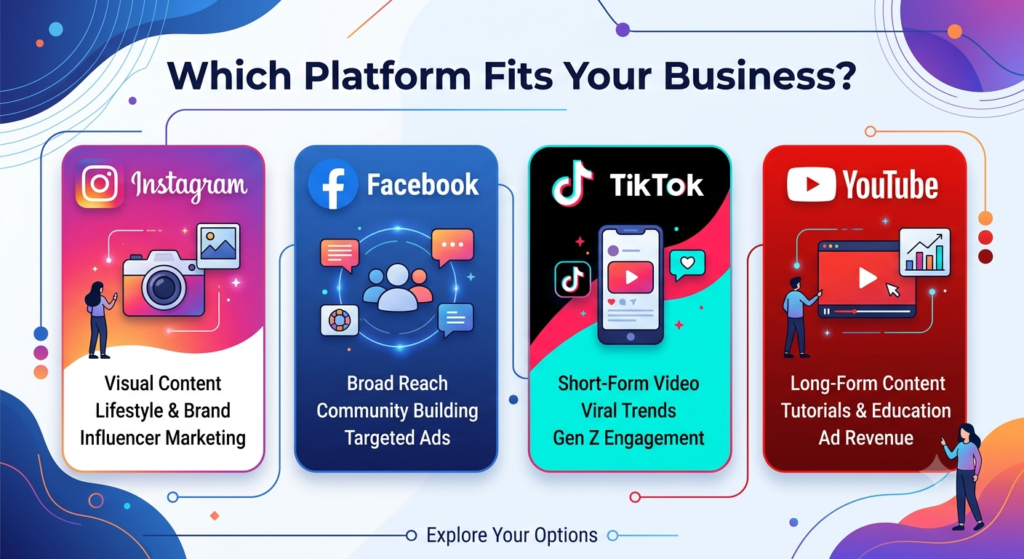
| Platform | Best For | Top Ranking Signal | Time to Rank | Winning Format |
|---|---|---|---|---|
| TikTok | How-to, local discovery, Gen Z buyers | Spoken keywords + captions | 2-4 weeks | Short video with on-screen text |
| Local services, visual businesses | Bio keywords + geotags | 4-8 weeks | Carousels | |
| YouTube | High-ticket research, tutorials | Title + transcript match | 2-3 months | 5-10 min searchable video |
| Local buyers 35+, reviews-driven | Complete page + reviews | 4-6 weeks | Keyword-led posts |
Common Mistakes That Keep Businesses From Ranking
Most businesses fail at social search for the same three reasons. They post without keyword research, so their content never matches what people type. They chase viral trends instead of answering customer questions, which wins views but not buyers. And they spread themselves across every platform instead of dominating one. Fix those three habits and you will outrank most of your local competition.
Read Also: The Power of a Digital Voice: Why Smart Brands Choose Strategy Over Noise
Start With One Platform, Not Four
Trying to optimize everything at once is how most businesses burn out and quit. Pick the platform where your customers already search. For local services, start with Facebook and Instagram. For visual or how-to driven businesses, start with TikTok or YouTube. Then apply the same discipline you would apply to Google SEO: keyword research, consistent posting, and content built around real customer questions.
Google knows you exist. Does social search? Moksh Digital can audit your social presence and show you exactly where you are losing searches your competitors are winning.
Ready to turn social searches into real customers? Let’s build your social search strategy
Frequently Asked Questions (FAQs)
1. Is social media really replacing Google as a search engine?
Not replacing, but splitting the traffic. Nearly one in three consumers now start their search on social platforms instead of Google, and that number passes 50 percent for Gen Z. Businesses need visibility on both to stay in front of buyers.
2. Which social media platform should my business optimize for search first?
Start with the platform where your customers already search. Local service businesses usually see the fastest results on Facebook and Instagram, while product-based and how-to businesses win faster on TikTok and YouTube. Dominating one platform beats posting on four.
3.How long does it take to rank in social search?
Weeks, not months. Niche searches on TikTok can rank in 2 to 4 weeks and Instagram in 4 to 8 weeks because competition is thinner than Google. YouTube takes longer, around 2 to 3 months, but rankings there can drive leads for years.
4. What is social SEO?
Social SEO is the practice of optimizing your social media profiles and content to rank in platform search results. It includes keyword-rich captions, searchable bio fields, alt text, location tags, and spoken keywords in videos. The goal is to appear when buyers search for your product or service instead of scrolling past you.
5. Does social media content help my Google rankings too?
Yes. Google now indexes public Instagram posts and short-form videos in its search results, and social profiles often rank on page one for brand and local searches. Optimized social content gives you two chances to get found instead of one.
6. How is social search different from traditional SEO?
Traditional SEO rewards answers, backlinks, and technical authority, and page-one rankings can take a year. Social search rewards proof, meaning real results, real people, and content that matches how buyers actually phrase questions. It also moves faster, with rankings possible in weeks.
7. What is multi-modal social search?
Multi-modal search means people now search social platforms with voice, photos, and full conversational questions, not just typed keywords. This shift rewards content built around natural, question-style phrases rather than exact-match keyword stuffing.