
The Power of a Digital Voice: Why Smart Brands Choose Strategy Over Noise

The Power of a Digital Voice: Why Smart Brands Choose Strategy Over Noise

Internet has never been this loud. Every second, millions of ads, posts, and videos fight for the same pair of eyes. The average person sees somewhere between 4,000 and 10,000 brand messages a day. Almost none of them stick. And what do most businesses do about it? They shout louder. Post more. Show up on every channel and hope something lands. It rarely does, because being loud isn’t the same as being heard.
Smart brands go the other way. They build a digital voice with actual strategy behind it. One that cuts through the noise, connects with the right people, and turns into loyalty over time. In this Moksh Digital article, we’ll walk through why shouting fails, what a digital voice strategy really looks like, and how to build one for your brand, step by step.


Why Shouting Fails in Digital Branding

Audience Fatigue in a Noisy World

Attention is the scarcest thing in marketing right now. People wake up to notifications, scroll past autoplay videos, and delete promotional emails before breakfast. Their defense is simple. They filter. They scroll. They mute. There’s a well-known phenomenon called banner blindness. Users have literally trained their eyes to skip anything that looks like an ad. The same thing is now happening to organic content. So when a brand shouts, whether that’s posting nonstop or pushing hard-sell messaging, it doesn’t stand out. It becomes part of the background noise people are already ignoring.

Here’s the uncomfortable truth. More volume doesn’t buy you more attention. It buys you more indifference.

Shouting Undermines Authenticity

People want brands to be real, and they can tell when one isn’t. Survey after survey shows that most buyers treat authenticity as a deciding factor in who gets their money. Loud, pushy campaigns might win a few short-term clicks, but they quietly burn through something much harder to earn back: trust.
Think about the words people use for brands that overpost and oversell. Desperate. Spammy. Fake. Once that label sticks, everything you publish afterward gets read through it. A brand that says less but means every word will always outlast one that says everything and means none of it.

Wasted Resources and Poor ROI

Shouting is also expensive. When you pump out high-volume content with no strategy behind it, your budget gets spread across channels, formats, and audiences that were never going to convert anyway. You end up with the pattern every marketer dreads: spend goes up, results stay flat, and the team burns out making content nobody reads. Do the math on it. Say you’re publishing 30 generic posts a month. That’s real hours in writing, website design, and scheduling. If those posts get almost no engagement, your cost per meaningful interaction is brutal. One well-researched, well-timed content piece could beat all 30 of them for a fraction of the effort. Real impact comes from clarity and focus. Not from trying to outshout competitors with deeper pockets.


Digital Voice vs. Brand Voice: What Is the Difference?

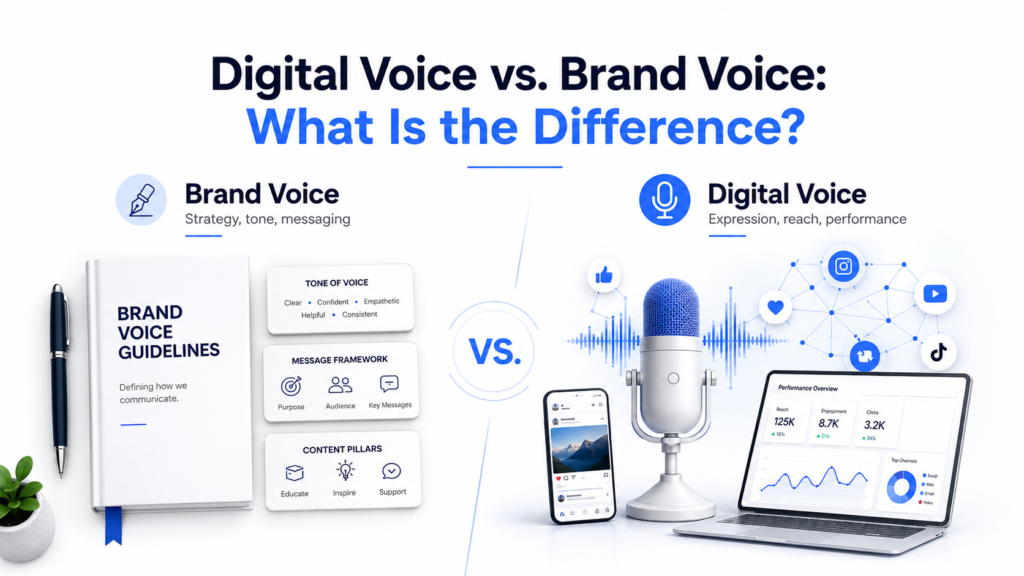
Digital Voice vs. Brand Voice

These two get used interchangeably, but they’re not the same thing. Your brand voice is your personality on paper. The tone, the vocabulary, the character you’ve written into your guidelines. It exists whether or not anyone’s listening. Your digital voice is that personality out in the world. It’s what you publish, where you publish it, how often, how you reply to comments, and even what you choose to stay quiet about. Brand voice is the script. Digital voice is the performance.

Why does this matter? Because most brands stop at the script. They write a tone document, file it away somewhere, and go right back to publishing reactive, inconsistent content. A real digital voice takes active decisions every single week. Which conversations to join. Which trends to skip. Which formats actually carry your message. Get both right and they feed each other. The brand voice keeps the digital voice consistent. The digital voice keeps the brand voice alive.


What It Means to Have a Strategic Digital Voice

Clarity Over Volume

Great brands don’t try to say everything at once. They pick one idea per message and make it impossible to miss.

Apple is the obvious example. Its campaigns are famously bare. A product shot. A short line. Lots of white space. No feature dumps, no walls of text. And yet every campaign instantly says innovation and elegance. That’s not luck. That’s disciplined subtraction.
Clarity forces a hard question: what’s the one thing your audience must remember? If you can’t answer that in a sentence, they won’t remember anything at all.

Authenticity That Resonates

A digital voice only works when it matches reality, because your audience checks. They read reviews. They compare your claims to their experience. And when there’s a gap, they’ll call it out in public.

Look at Patagonia. It doesn’t just talk about sustainability. It builds it into products, supply chains, repair programs, and activism. It once ran an ad telling people not to buy its jacket unless they actually needed one. That’s why its voice carries weight. The words and the actions line up.

The lesson is simple. Your digital voice isn’t what you say about your brand. It’s the overlap between what you say and what you actually do.

Storytelling That Connects

Humans are built for stories, not spec sheets. Neuroscience research shows stories light up more of the brain than plain facts and stay in memory far longer.

Coca-Cola’s “Share a Coke” campaign is the classic case. It never shouted about ingredients or price. It just printed people’s names on bottles and invited them to share one with someone they cared about. The product became an excuse for connection. Sales climbed, social sharing took off, and the campaign eventually ran in more than 80 countries.

Strategic brands find the human story inside the product. Then they let the story do the selling.


Key Strategies Smart Brands Use

Listening First, Speaking Second

A digital voice isn’t a megaphone. It’s one half of a conversation.

Smart brands invest in listening before they invest in content calendars. They track what customers complain about, what they ask, and the exact words they use to describe their problems. Mentions, reviews, community threads. All of it turns into a content roadmap.

The payoff is precision. When your content answers questions your audience is already asking, in the language they already use, engagement stops being a fight. You’re not interrupting the conversation anymore. You’re in it.

Consistency Across Platforms

A strong digital voice feels the same everywhere. The Instagram caption, the LinkedIn article, the support email, the checkout page. All of it should sound like one brand. There’s real psychology behind this. The mere exposure effect shows that familiarity breeds preference. Every consistent touchpoint deposits a little trust. Every inconsistent one withdraws it.

Consistency doesn’t happen by accident, though. It needs documentation. Write down your tone, your vocabulary, the words you never use, and how your voice flexes by platform without losing its character. Playful on Instagram and buttoned-up on LinkedIn? Fine. Warm on Instagram and cold in support emails? That’s a problem.

Choosing Silence as a Strategy

Sometimes the strongest move is saying nothing. Not every trend deserves your take. Not every news cycle needs your comment. Brands that jump on every viral moment teach their audience to expect noise. Brands that speak selectively teach their audience to pay attention when they do. Scarcity works in communication the same way it works in products. A quick filter helps here. Does this post serve our audience, or does it just fill our calendar? If the honest answer is the calendar, skip it. Silence protects the value of your voice.

Aligning Voice With Brand Actions

Your digital voice goes way beyond marketing. It lives in your onboarding emails, your invoice reminders, your refund policy, and how your team handles a one-star review. Tesla proves this at scale. The company spends next to nothing on traditional advertising. Its voice comes through product launches, direct communication from leadership, and a confident social presence. Love the brand or not, the voice is unmistakable, and it’s backed by what the company ships, not just what it posts.

So audit every touchpoint. If your ads promise “customer obsession” but your support inbox takes five days to answer, your real voice is the five-day wait.


Common Mistakes That Weaken a Digital Voice

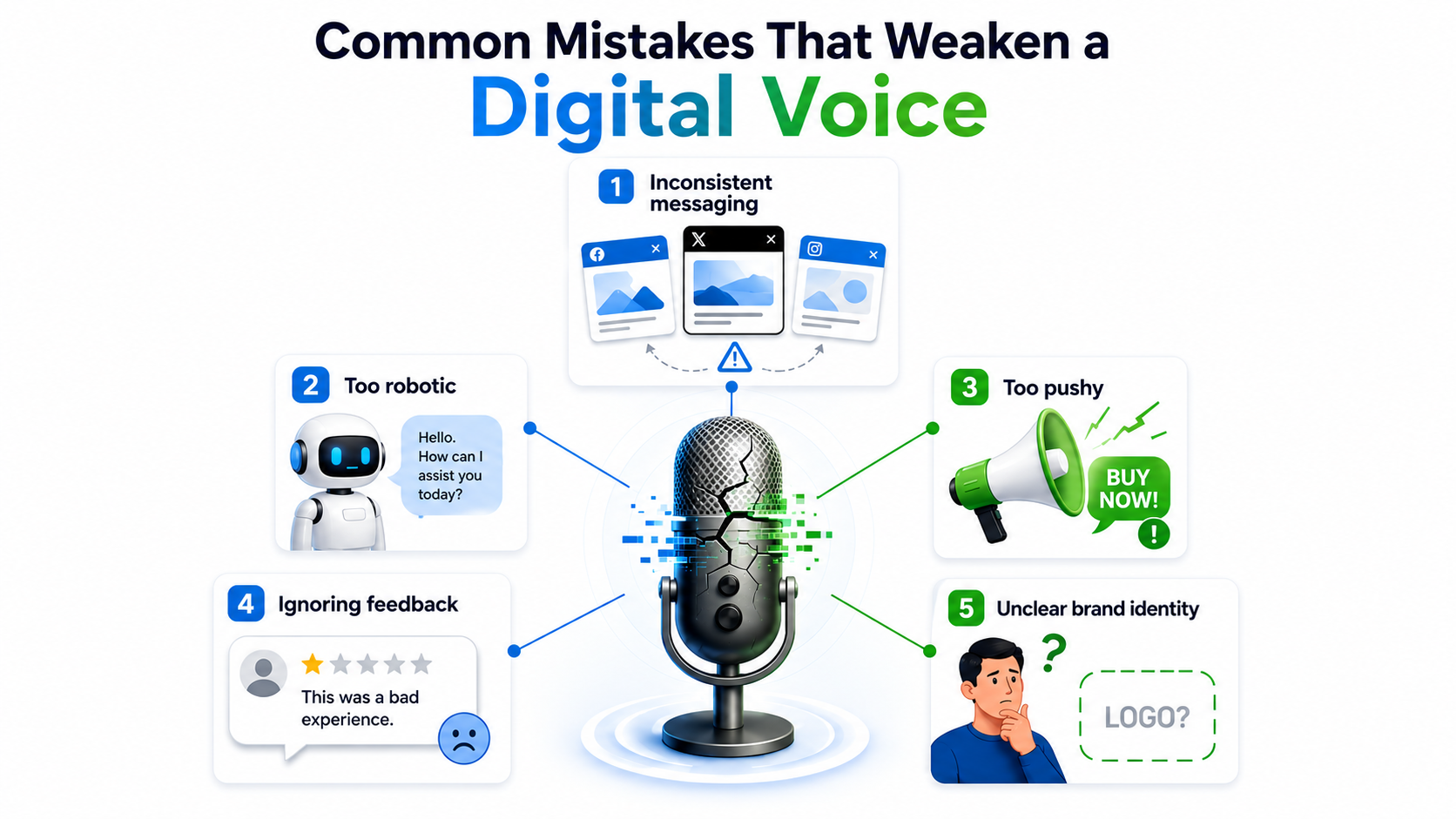
Common Mistakes That Weaken a Digital Voice

Even well-meaning brands sabotage their own voice. Here’s what to watch for.

Chasing every trend. A dental clinic hopping on a viral meme. A B2B software firm chasing pop culture moments. A law firm doing dance trends. When content has nothing to do with your expertise, people notice, and every off-brand post chips away at what you stand for.

Sounding like everyone else. If a competitor could publish your post by just swapping the logo, you don’t have a voice. You have a template. Generic phrases and stock claims are the written version of silence.

Letting different teams speak differently. Marketing sounds polished. Sales sounds pushy. Support sounds like a robot. To the customer, it’s all one brand, and the mismatch reads as disorganized at best and dishonest at worst.

Talking only about yourself. A feed full of awards, launches, and self-congratulation ignores the only question your audience actually has: what’s in it for me? Strong voices spend most of their time on the audience’s problems, not the brand’s trophies.

Abandoning the voice under pressure. The real test isn’t the good weeks. It’s the product delay, the bad review, the public complaint. Brands that go quiet, get defensive, or switch to legal-speak in those moments can undo years of voice-building in days.


How Smaller Brands Can Outvoice Bigger Competitors

Nike, Tesla, and Coca-Cola have budgets most businesses will never see. Which is exactly why voice matters more for smaller brands, not less. Big brands win on reach. Small brands win on resonance. A regional firm can reply to every comment personally, speak to local context no national player understands, and change its messaging in days instead of quarters. Those aren’t consolation prizes. They’re structural advantages. Specificity is the small brand’s sharpest weapon. A giant has to speak to everyone, which drags its message toward the generic middle. A focused brand can talk to one audience in the exact language that audience uses. When a prospect reads your content and thinks “this was written for me,” no ad budget on earth competes with that.

The playbook is straightforward. Pick a narrow audience. Learn their exact vocabulary and pain points. Show up consistently in the two or three channels where they actually spend time. Depth in two channels beats a shallow presence in eight, every time.


Your Digital Voice in the Age of AI Search

There’s a shift underway that most brands haven’t caught yet. People aren’t just searching Google anymore. They’re asking ChatGPT, Gemini, and Perplexity for recommendations, and those tools answer based on how your brand shows up across the web.

That raises the stakes on your digital voice. AI systems learn about your brand from your website, your content, your reviews, and how consistently you describe what you do. Give them a clear, consistent story and they can retell it. Give them scattered, generic messaging and you simply don’t show up in AI-generated answers.

So consistency now pays twice. It builds trust with the humans reading your content, and it builds recognition with the AI systems those humans increasingly lean on. The brands investing in a clear digital voice today are the ones that will get recommended tomorrow, in channels their competitors haven’t even thought about.


How Your Brand Can Shift From Noise to Strategy

1. Audit your current voice. Pull your last 90 days of content across every channel and score each piece honestly. Was it clear? Did it serve the audience? Did it sound like you? Patterns show up fast. Most brands find out they’ve been publishing three different voices and zero strategies.

2. Define your values and tone. Build a voice guideline. Include your brand’s personality traits, the words you use, the words you ban, sample sentences, and side-by-side examples of on-voice versus off-voice copy. Keep it short enough that your team actually reads it.

3. Have real conversations. Trade the monologue for dialogue. Reply to comments with substance, not emojis. Answer questions in the communities where your audience hangs out. Feature customer stories. One genuine interaction builds more trust than a thousand paid impressions.

4. Choose quality over quantity. Cut your publishing volume and put that time into depth. One post that solves a real problem, backed by proof and written in your voice, beats a week of filler. Set a simple bar: if a piece wouldn’t be missed, don’t publish it.

5. Measure what matters. Impressions flatter you. Trust converts. Track saves, shares, reply quality, branded search, repeat visitors, and sentiment. Those signals tell you whether your voice is landing or just circulating. Check them monthly and adjust based on what your audience rewards.

Read Also: From Traffic to Revenue: Turning Your Website into a Lead Engine


Conclusion

Shouting isn’t a strategy. It’s a shortcut that burns budget, wears out your audience, and eats away at trust. The brands winning right now are the clear ones, the honest ones, the consistent ones. They know influence doesn’t come from noise. It comes from resonance. If you want your brand to be remembered and not just noticed, it starts with your digital voice.

Ready to amplify your message the smart way? Let’s craft your brand’s digital voice today.


Frequently Asked Questions (FAQs)

1. What does it mean for a brand to shout online?
It means burying your audience in loud, frequent, or pushy content instead of saying something worth hearing. Think nonstop posting, aggressive sales language, and jumping on every trend for no reason.

2. Why is a digital voice important?
It’s what builds recognition, trust, and real connection. It’s the difference between being one of thousands of messages someone scrolls past and being the one they stop for.

3. How can a brand find its digital voice?
Start with your values. Listen to how customers actually talk about their problems. Write your tone down in clear guidelines, then hold every platform and touchpoint to it.

4. Do brands need to post every day to stay relevant?
No. Quality and timing beat frequency. Two genuinely useful posts a week will build more trust than daily filler ever will.

5. What is the difference between brand voice and digital voice?
Brand voice is your personality and tone as defined. Digital voice is that personality in action, covering what you publish, how you respond, and what you choose to skip.

6. Does digital voice affect how AI tools recommend brands?
Yes. Tools like ChatGPT and Perplexity describe and recommend brands based on the content and messaging they find online. A clear, consistent voice makes your brand easier for AI to understand and surface.

7. How long does it take to build a strong digital voice?
Plan on three to six months of consistent effort before results compound. The voice itself can be defined in weeks, but recognition and trust come from repetition. Brands that hold steady past six months usually see better engagement quality, more branded search, and more inbound interest.


Blogs

Explore our upcoming and past events designed to spark ideas, share expertise, and help businesses grow through meaningful conversations.

Social Media Search Engine: How to Rank on TikTok, Instagram, YouTube & Facebook

Social Media Search Engine: How to Rank on TikTok, Instagram, YouTube & Facebook

From Traffic to Revenue: Turning Your Website into a Lead Engine

From Traffic to Revenue: Turning Your Website into a Lead Engine

The Death of Keywords: Why SEO Masters Are Building Decision Engines, Not Search Rankings

The Death of Keywords: Why SEO Masters Are Building Decision Engines, Not Search Rankings

Ready to work with us ?