
The Authority Blog Formula Used by Fast-Growing US Companies

Mick Shah

10 min read
The Authority Blog Formula Used by Fast-Growing US Companies

Introduction

For years, businesses have treated blogging as a traffic strategy: find a keyword, write an article, and aim for page one. Search has changed, with AI-powered search engines and recommendation platforms increasingly evaluating expertise and authority alongside keywords. For US companies, a strong blog can demonstrate genuine expertise, earn customer trust, and provide credible information that AI systems can reference. Fast-growing companies are shifting from publishing more content to building authority, a strategy Moksh Digital helps brands put into practice. 

The gap between random posting and systematic publishing is measurable. According to OmniBound’s 2026 B2B content marketing research, companies with active blogs generate 67 percent more leads monthly than those without, and organic traffic converts at 2.8 times the rate of paid. A working content strategy for fast-growing companies is not about volume; it is about compounding authority.

What Is the Authority Blog Formula?

The authority blog formula makes your brand a trusted source in its category.

Instead of publishing disconnected posts, it creates a focused content system around the topics, questions, and expertise that matter most to your audience. Each article supports a broader authority strategy through original insights, useful data, expert knowledge, clear answers, and strategic internal linking. This approach helps your content build stronger visibility across search, AI-powered answers, and recommendation platforms while giving customers more reasons to trust your brand.

The Four Pillars of an Authority Blog

An effective authority blog brings four elements together to build trust, relevance, and visibility:

  • One Core Topic: Own one pillar topic thoroughly before moving to another theme.
  • Real Buyer Questions: Use questions from sales calls, customer conversations, and support tickets.
  • Original Data & Insights: Share proprietary data, experience, and perspectives only your team can provide.
  • Citable Content Structure: Organize content so search engines and AI systems can easily understand and reference it.

What Metrics Prove a Blog Is Building Authority?

A brand authority content plan only works when measured on signals that reflect real influence, not surface activity. Pageviews hide what a blog is doing for the business, which is why content marketing best practices 2026 pair rankings with authority and pipeline metrics. The numbers worth tracking:

  • Organic ranking depth: how many posts rank in the top three for pillar-related queries.
  • AI citation frequency: how often your content is quoted or referenced inside AI Overviews, ChatGPT, and Perplexity answers.
  • Featured snippet ownership: share of question-based snippets your brand controls within the pillar.
  • Branded search growth: month-over-month lift in searches for your brand name and product terms.
  • Backlinks from industry sources: volume and quality of links from publications and peers, a core signal of authority.
  • Assisted conversions: deals and demos where a blog post appeared somewhere in the buyer’s journey.

Together, these metrics show whether a content marketing formula for growth is producing real authority or just activity, the honest test any blog has to pass.

Turn Your Blog Into an Authority Engine With Moksh Digital. 

How Do Fast-Growing US Companies Blog Differently?

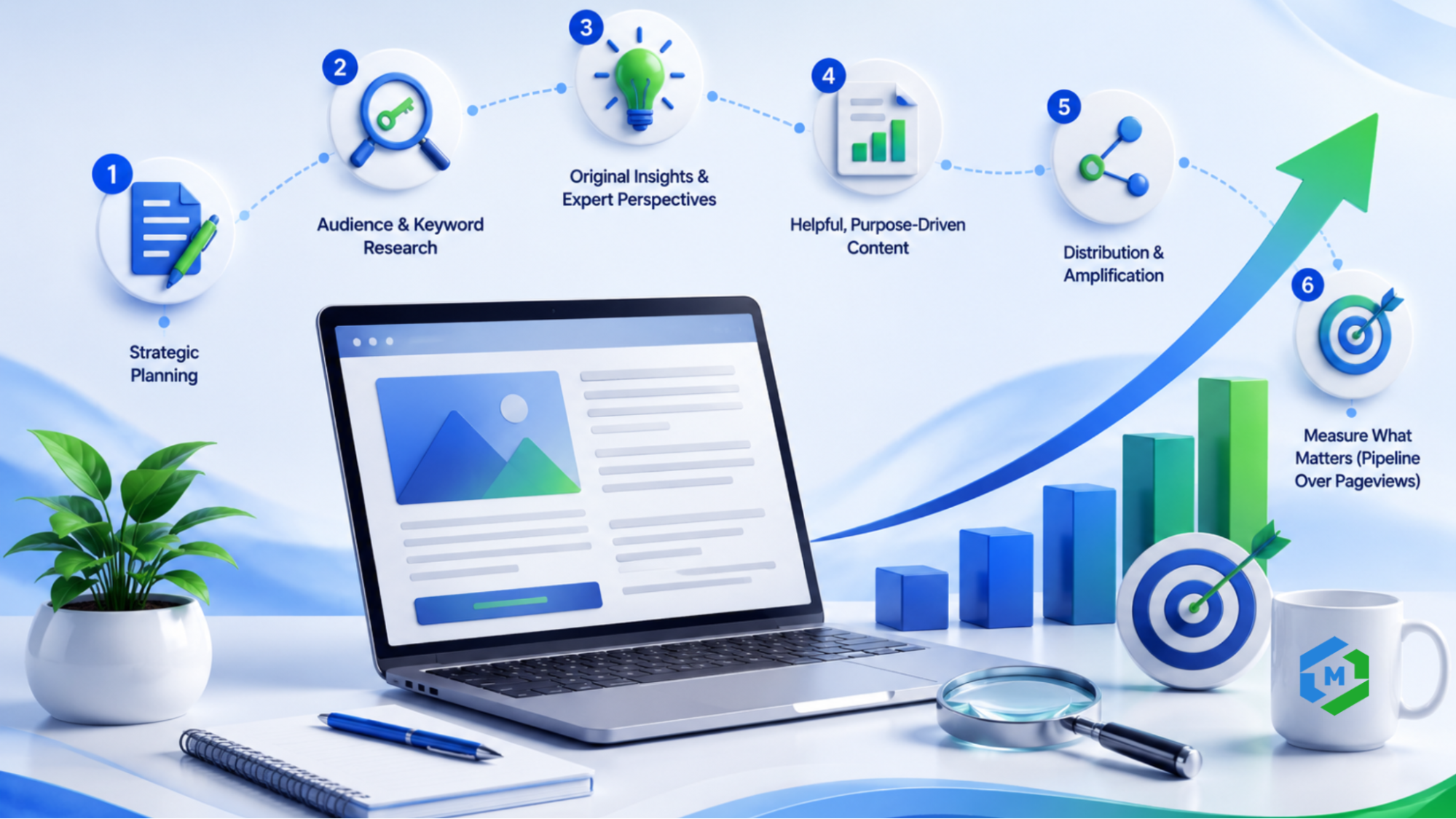
A content marketing strategy for U.S. companies starts with a documented plan, not random publishing. Every post is built around a clear pillar, keyword cluster, and measurable business goal. A structured high-growth company content strategy produces better results because every article has a purpose.

In 2026, a successful B2B blogging strategy treats the blog as a revenue channel, not a PR tool, and supports it with social distribution to extend reach and engagement.

Content answers buying questions, includes a clear next step, and is measured by pipeline instead of page views.

Thought leadership SEO helps brands stand out by sharing original perspectives that AI can quote and cite.

This approach creates a scalable content strategy for startups, where every post builds long-term authority and business value.
How Do Fast-Growing US Companies Blog Differently?

How Does Authority Blogging Impact Business Growth?

Authority blogging helps businesses build lasting visibility, trust, and leads by consistently demonstrating expertise.

  • Builds Long-Term SEO Value: Earns rankings and steady organic traffic over time.
  • Gets Your Brand Cited by AI: Creates opportunities to appear in AI answers and recommendations.
  • Strengthens Topical Authority: Deep coverage helps search engines recognize your expertise.
  • Turns Traffic Into Leads: Strategic CTAs connect content to demos, consultations, and downloads.
  • Earns Backlinks & Mentions: Original content attracts references from websites and industry sources.
  • Builds Customer Trust: Consistent expertise gives potential customers confidence in your brand.
  • Supports Future Content: A strong content foundation helps new blogs rank, connect, and build authority.

Build an Authority-First Content Strategy With Moksh Digital.

Traditional Blog vs Authority-Driven Blog

Traditional blogs focus on publishing frequently, targeting keywords, and generating traffic through individual articles. Each post often stands alone without a broader strategy.

Authority-driven blogs build depth around core topics, answer real buyer questions, share original insights, and connect related content. The two approaches look similar on a content calendar, but they produce very different business outcomes.


Traditional Corporate Blog

Authority-Driven Blog

Purpose

Fill the content calendar

Own the category conversation

Topic scope

Broad and reactive

One pillar, deeply covered

Proof used

Third-party statistics

Original data and firsthand experience

Cadence

Whenever time allows

Consistent, planned by quarter

Distribution

Posted and forgotten

Refreshed, repurposed, internally linked

Payoff

Page views this month

Compounding rankings, citations, and leads

 Volume creates noise. The authority blog formula compounds. Every new article strengthens the ones before it, and every refresh extends the lifespan of what already ranks.

How to Turn Blog Authority Into Brand Demand

Every authoritative article is a free impression, and consistent impressions compound into demand. When readers see your brand explaining the same topic across blog posts, AI answers, and industry roundups, they eventually search by name, and branded search is the highest-intent traffic marketing can produce.

Turning visibility into pipeline is a matter of intent. A working content pillar strategy links related articles so a reader who lands on one moves easily to the next, gated resources answer real buyer questions instead of acting as arbitrary content walls, and a clear blogging formula for lead generation ties each post to a specific next step. Citations feed branded search, branded search strengthens your entity signals, and stronger entity signals make AI engines more likely to cite you next time.

How to Measure Authority Blog Performance

A brand authority content plan only works when it is measured on signals that reflect real influence, not surface activity. Page views hide what a blog is actually doing for the business, which is why content marketing best practices in 2026 pair rankings with authority and pipeline metrics. The numbers worth tracking:

  • Organic ranking depth: how many posts rank in the top three for pillar-related queries.
  • AI citation frequency: how often your content is quoted or referenced inside AI Overviews, ChatGPT, Perplexity, and Gemini answers.
  • Featured snippet ownership: the share of question-based snippets your brand controls within the pillar.
  • Branded search growth: month-over-month lift in searches for your brand name and product terms.
  • Backlinks from industry sources: the volume and quality of links from publications and peers.
  • Share of voice: how often your brand shows up on the pillar topic compared with competitors.
  • Assisted conversions: deals and demos where a blog post appeared in the buyer journey, including sales calls that reference specific posts by name.

Together, these KPIs show whether a content marketing formula for growth is producing real authority and pipeline, or just activity. That is the question a CFO cares about most, and the honest test any blog has to pass.


How to Measure Authority Blog Performance

What Does the Future of Blogging Look Like?

Blogging is evolving from a traffic channel into a long-term brand asset and trust hub. Brands will focus on topic ownership, original expertise, and content with a clear purpose across awareness, consideration, trust, leads, and conversions. Authority content will attract prospects, answer objections, support sales, and strengthen social, email, PR, and thought-leadership efforts. As AI visibility becomes a marketing goal, businesses will optimize content for citations and recommendations, not just rankings. Case studies, customer insights, proprietary data, and expert opinions will increasingly outperform generic content.

Create Content That Earns Rankings, Citations, and Leads With Moksh Digital. 

Conclusion

The authority blog formula turns content from a publishing task into a growth system. By owning valuable topics, demonstrating real expertise, and supporting the buyer journey, businesses can build lasting authority, visibility, trust, and qualified leads.

Moksh Digital helps businesses turn this strategy into measurable growth through content strategy, topic clusters, authority-led blogs, SEO, AEO, and GEO. We identify high-value opportunities, develop expertise-driven content, and optimize it for search and AI visibility.

The goal is not to publish more. It is to build a content ecosystem that attracts the right audience, supports conversions, and positions your brand as a trusted source customers and AI platforms recommend.

Book a Discovery Call with Moksh Digital.

FAQs

1. How long does it take to build blog authority?

Building blog authority takes time and depends on content quality, consistency, competition, and relevance. A strong content pillar strategy builds visibility and trust gradually.

2. How many blog posts should a company publish each month?

There is no fixed number that guarantees results. A scalable content strategy for startups should prioritize consistent, high-quality content over volume.

3. What makes a blog post authoritative?

Authoritative content combines expertise, credible information, original insights, and useful answers. Thought leadership SEO helps position expert perspectives around important industry topics.

4. Should businesses prioritize evergreen or trending content?

Both have value and serve different purposes. A high-growth company content strategy can use evergreen content for lasting visibility while addressing timely topics when relevant.

5. How often should an authority blog be updated?

Content should be reviewed when statistics, industry information, or customer needs change. Following content marketing best practices in 2026 helps keep valuable content accurate and relevant.

6. Can small businesses build topical authority through blogging?

Yes. A brand authority content plan can help small businesses focus on specific topics where they have genuine expertise and consistently build relevance.

7. Does blogging improve brand credibility?

Consistently demonstrating expertise can increase customer confidence in a company’s knowledge. A B2B blogging strategy can turn educational content into a long-term credibility asset.


In this article
Outsourcing IT
Need a stronger MSP partner?

Talk to Moksh Tech about dedicated engineers, 24/7 NOC, and white-label support built exclusively for MSPs.

Industry Pioneer
Mick Shah
CEO & Founder, Moksh Group

Bhaumik Shah is the CEO and Founder of Moksh Group and one of the MSP industry’s most forward-thinking voices. With more than 25 years of experience in managed services, he has spent his career at the intersection of technology, operations, and business growth.

Today, he leads an AI innovation firm with a singular focus: helping MSPs move beyond break-fix and reactive support to become Managed Intelligence Providers (MIPs)—businesses that leverage AI to deliver proactive, scalable, and future-ready client outcomes. His work is shaping what the next generation of managed services looks like.

Related articles