Walk into any marketing meeting in 2026 and you’ll hear a soup of new acronyms. AEO. GEO. LLMO. AI SEO. Some people use them interchangeably. They shouldn’t, because each one targets a different surface, rewards different tactics, and gets measured differently. Here’s the plain-English breakdown.
AEO: Answer Engine Optimization
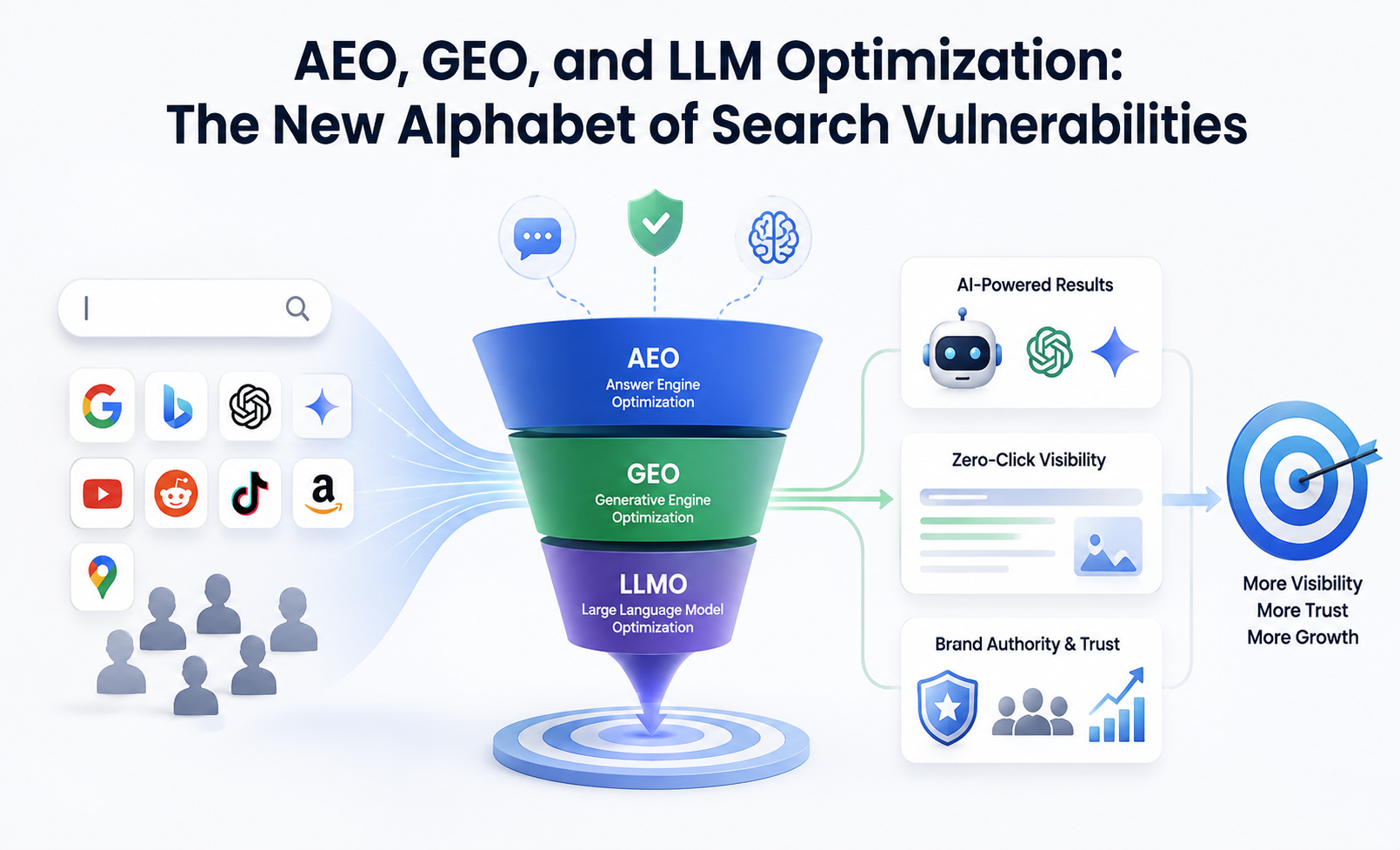
AEO is about becoming the direct answer. It grew out of featured snippets, People Also Ask boxes, and voice assistants, and it now covers Google’s answer boxes and the extractable parts of AI Overviews.
The playbook is directness over cleverness. Match your headings to the exact questions people ask, then answer them immediately in one or two clean sentences. Structure content for extraction: FAQs, tables, bullet lists, tight definitions. Add schema markup, especially FAQPage and HowTo. Write in plain, precise language, because ambiguity kills extractability.
The success metric is simple: did you win the answer box, the snippet, or the spoken response? If someone asks their phone “what is slab nesting” and your definition comes back, that’s AEO working.
GEO: Generative Engine Optimization
GEO goes one level deeper. It’s the practice of getting your brand cited inside the answers that generative engines write: AI Overviews, ChatGPT search, Perplexity, Gemini, Copilot. The term came out of a 2023 research paper from Princeton, Georgia Tech, and Allen Institute researchers, and their findings are still the most practical guide in the field.
They tested content modifications across 10,000 queries and measured what actually increased citation probability. The results should reshape how you write:
- Adding expert quotes lifted citation probability by around 41%. Models treat quotation marks and attribution as a credibility signal.
- Adding statistics lifted it by roughly 30%. Numbers signal factual density.
- Adding inline citations to authoritative sources also lifted it by about 30%. Content that cites its own sources builds a chain of trust.
- Keyword stuffing dropped citation probability by about 9%. The models detect unnatural text and penalize it.
Notice what’s happening here. The tactics that win AI citations are the exact tactics that make content genuinely good. Quotable data, named experts, cited sources, clear structure. GEO isn’t a trick. It’s rigor, made machine-readable. One more mindset shift GEO demands: citation is not winner-take-all. An AI answer typically cites three to five sources, and being one of them is the win. You’re no longer fighting for a single #1 slot. You’re working to become a credible corroborating voice the model keeps reaching for.
LLMO: Large Language Model Optimization
LLMO zooms out from individual pages to your brand’s entire footprint in the model’s knowledge. It asks a bigger question: when someone types your category into ChatGPT, Claude, or Gemini, how does the model represent you? Does it know who you are, what you do, and why you’re credible?
This is entity work, and it’s slower and more structural than AEO or GEO:
Build consensus about your facts. LLMs favor information that appears consistently across their training data and retrieval sources. If your service list says one thing on your website, another on your directory listings, and a third on LinkedIn, the model loses confidence and may omit you entirely rather than risk being wrong. Your name, locations, services, and core claims need to match everywhere. Think of it as the consensus engine effect: consistency is what lets the AI triangulate you with confidence.
Feed the machine structured signals. An emerging standard called llms.txt works like a sitemap for AI crawlers, a curated index of your most important pages with brief descriptions. Not every platform reads it yet, but early adopters gain a structural head start. At minimum, check your robots.txt isn’t accidentally blocking AI crawlers from your best content.
Play the long game. The entity profile you build today shapes how models represent you 12 to 24 months from now, as they retrain and update. In practice, businesses doing this work typically see measurable citation increases in tools like Perplexity within 3 to 6 months, and AI Overview inclusion within 2 to 4 months once quality signals are established. Each citation and each authoritative mention compounds.
Know your engines, because they don’t behave the same
Different AI platforms source and cite differently, and the details matter:
- Google AI Overviews disproportionately cite pages that already rank in the top 10 organic results. Strong traditional SEO is your entry ticket. FAQ and HowTo schema, short definitions, and visuals improve inclusion odds.
- ChatGPT often lifts structured formats like bullet points and FAQs almost verbatim. It also runs “query fan-out,” breaking your prompt into one to three background searches. Find those searches, build dedicated pages targeting them, and you’ll show up in its answers.
- Perplexity shows its searches openly, always includes citations, and rewards freshness, authority, and original data. It leans heavily on Bing’s index, which means Bing SEO quietly matters again.
- Microsoft Copilot leans on LinkedIn for B2B queries. If you sell to businesses, your LinkedIn presence now feeds an answer engine.
- Gemini analyzes multimodal content, so creating graphics design carry real weight.
So where does “AI SEO” fit?
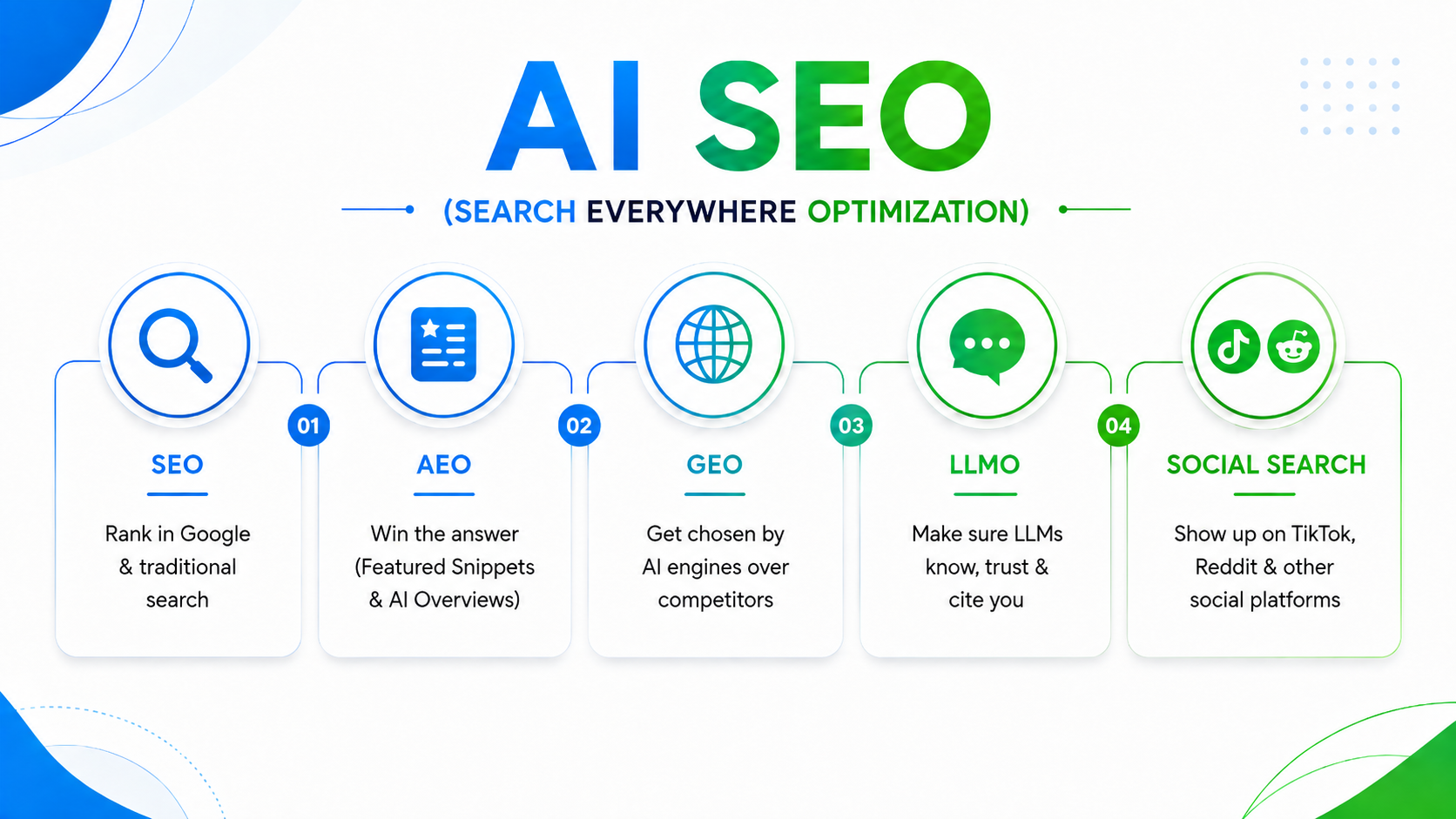
AI SEO is the umbrella. Some in the industry now call it Search Everywhere Optimization: traditional SEO plus AEO plus GEO plus LLMO plus social search on Reddit and TikTok. Whatever label you prefer, the operating principle is the same, and it’s the most reassuring truth in this whole shift:
You are not building four separate assets. You are building one asset with four payoffs.
A page with a crisp definition up top, question-matched headings, a comparison table, quotable statistics, expert attribution, and clean schema can rank in Google, win the featured snippet, get pulled into an AI Overview, and earn a Perplexity citation, all at once. SEO gets you into the pool of pages the AI reads. AEO makes your content easy to extract. GEO makes the AI choose you over competitors. LLMO makes sure the model knows who you are in the first place.
One warning before we move on. The GEO gold rush has attracted operators promising guaranteed AI placement. Nobody can guarantee that. Anyone who says otherwise is selling you something that doesn’t exist.