
Why Zero-Click Searches Are Exploding & How to Still Capture Leads

Mick Shah

11 min read
Why Zero-Click Searches Are Exploding & How to Still Capture Leads

Introduction

Search behavior has shifted more in the last two years than in the previous decade. Ask a question, and Google, Bing, Claude, ChatGPT, Perplexity, or any of the AI-powered engines now competing for that query hands back a complete answer before you scroll. That is the reality of zero-click searches, where users find the information they need directly on the search results page without visiting a website.

The term entered mainstream SEO around 2019 as featured snippets absorbed more traffic, then accelerated with the rise of AI Overviews in 2024 and 2025.

According to SparkToro’s 2026 study covered by Search Engine Land, 68 percent of US Google searches now end without a click, up nearly 23 percent since 2024. If your brand cannot earn a citation inside an AI answer, you disappear from searches that once sent leads.

Moksh Digital helps businesses close that gap, restructuring content to earn AI citations and building channels that capture leads even when the click never happens.

What Is a Zero-Click Search, and Why Does It Matter for Your Business?

Picture the last time you searched for something and never opened a single link. The engine resolved the query so completely that clicking through felt unnecessary. That single moment answers the question of what a zero-click search is: the searcher gets what they came for, and the business behind the content gets only an impression, not a visit.

These zero-click search results show up through familiar SERP features:

  • AI Overviews, 
  • Featured snippets, 
  • Zero-click answer boxes, 
  • Knowledge panels, 
  • People Also Ask, 
  • Local Packs, and 
  • Direct answers. 

Today’s results pages resolve the question themselves, which is why this shift matters for any business that relies on organic traffic for leads.

Why Zero-Click Searches Are Growing

Several changes in search are making zero-click searches more common, and each one is changing how users interact with results.

Search Engines Are Answering, Not Just Linking

Google and other search platforms increasingly provide direct answers within the results page, so users do not always need to visit a website to find basic information.

AI Overviews Are Changing Search Behavior

AI Overviews summarize information from multiple sources and answer complex queries directly, reducing the need to visit several websites to piece together an answer.

SERPs Are Becoming More Feature-Rich

Featured snippets, People Also Ask, knowledge panels, local packs, and shopping results deliver more useful information inside the search results themselves.

Users Want Faster Answers

Searchers expect quick, concise answers, especially when they have a specific question and do not need to explore several websites to find it.

Mobile Search Encourages Quick Decisions

Mobile users often rely on the information shown directly in search results because they want to make a quick decision without opening multiple pages. Current figures show that 77 percent of mobile searches end without a click, compared with 56 percent of desktop searches.

Search Is Becoming More Conversational

Users are asking longer, more specific questions, and search engines are getting better at understanding them. Voice search strengthens this trend by letting users ask questions naturally and receive an answer without browsing through results.

Google Is Becoming a Decision Layer

Search increasingly helps users compare, evaluate, and decide instead of simply pointing them to websites. Google AI Mode takes this further with conversational answers for more queries, while growing trust in AI answers makes users comfortable acting without clicking through.

The top organic result already loses roughly 58 percent of its clicks once an AI Overview appears. Studies on the AI Overviews SEO impact describe this as the clearest example of Google AI Overview traffic loss. Taken together, these forces point to a broader AI search behavior shift, where ranking well is no longer enough on its own.

Search Engines Are Becoming Decision Engines

Search engines help users find and compare information by ranking relevant pages against a query. Users typically click through several results to judge what is useful or trustworthy.

Decision engines go a step further. They interpret the query, weigh information from multiple sources, and deliver a direct recommendation or answer. Instead of sending users to several websites to decide for themselves, the engine makes the decision inside the search experience.

The distinction between decision engines vs. search engines matters because the decision is moving off your website and into the answer. Visibility no longer depends only on ranking first. It depends on becoming a source an AI engine trusts enough to reference, summarize, or recommend.

Moksh Digital helps businesses adapt by restructuring content so search and AI engines can understand, extract, and confidently use it.

Search Engines vs Decision Engines


Search Engines (Old Model)

Decision Engines (New Model)

User input

Short keywords

Full conversational questions

Output

Ranked links

One synthesized answer

Your goal

Rank number one, win the click

Get cited inside the answer

Winning content

Keyword-optimized pages

Structured, quotable, entity-rich content


Success metric

Organic traffic

Mentions, citations, branded search, leads

 Ranking is no longer the finish line. Being the source the answer is built from is.
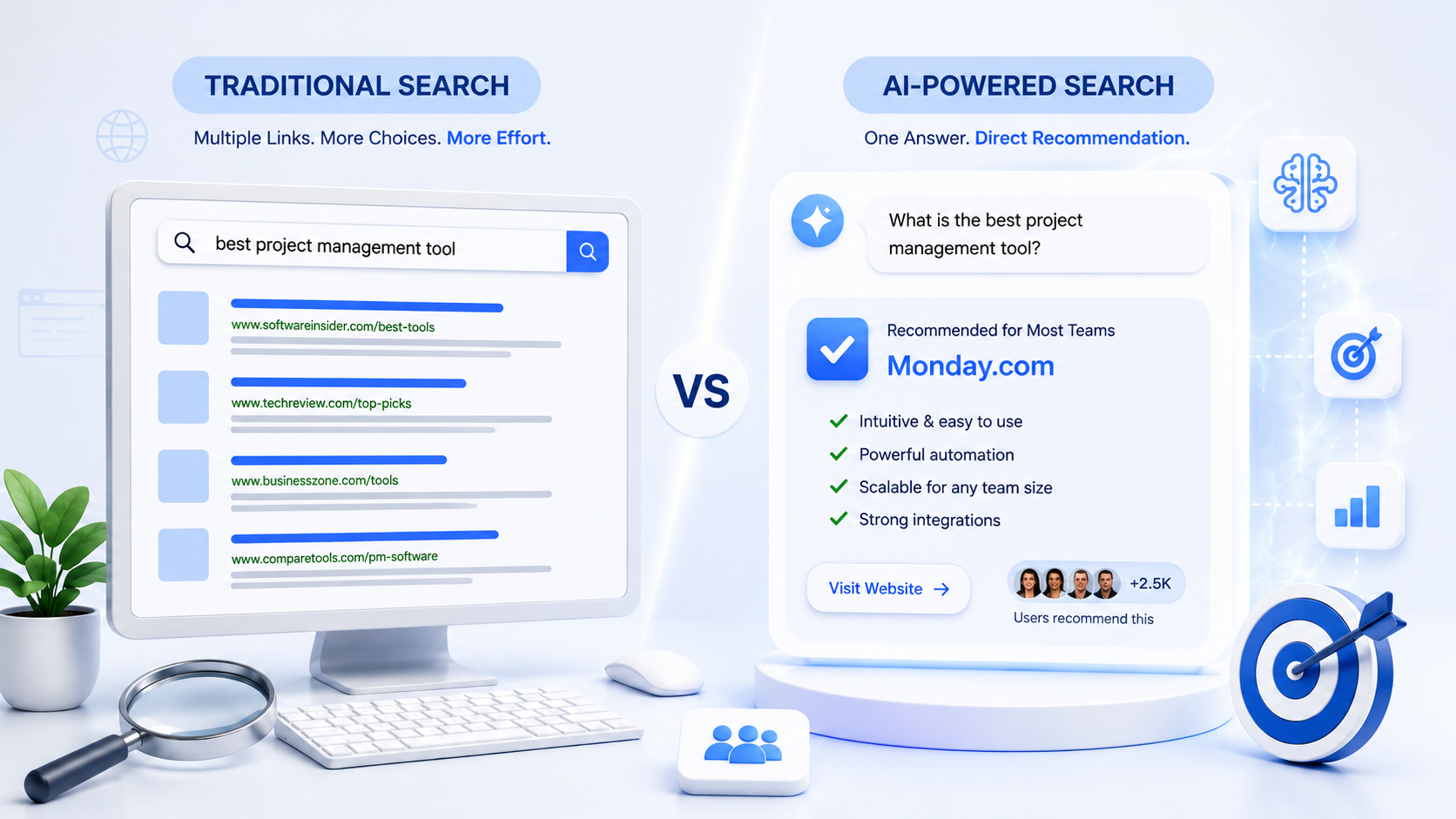
Search Engines vs Decision Engines

Zero-Click Searches and Business Visibility

As AI answers more questions directly, visibility and brand authority matter as much as website traffic.

  • Zero-click searches reduce website visits by answering questions directly in search results.
  • Many businesses are seeing organic traffic decline in 2026, which makes search visibility more valuable than ever.
  • Brand visibility without clicks is becoming a key metric, because AI mentions influence buying decisions before a website visit.
  • Traditional attribution is getting harder, since buyers discover brands through AI and return later through branded searches.

Is AI Citing Your Brand or Your Competitors?

When a buyer searches your category on ChatGPT or through an AI Overview, is your business the one named? Most business owners have never checked.

Moksh Digital’s GEO Audit shows how your brand appears across these platforms compared with competitors, and what it would take to close the gap.

SEO vs AEO vs GEO: Why You Need All Three

SEO still matters. Strong zero-click searches SEO earns the rankings AI pulls its answers from, and content now creates value even without a click once it appears inside an AI result. That is where two newer disciplines come in.

Answer engine optimization (AEO) makes content easy to quote, using clear answers and structured data for AI visibility so your pages can be lifted into an AI response. It answers the question every marketing team is now asking, which is how to rank in AI answers.

Generative engine optimization (GEO) helps AI recognize and recommend your brand. Strong LLM search optimization improves your odds of ranking in ChatGPT answers.

SEO vs AEO vs GEO


SEO

AEO

GEO

Purpose

Win clicks from rankings

Win extracted answers on the SERP

Win citations inside AI answers

Optimizes for

Google rankings

Snippets, PAA, AI Overviews

ChatGPT, Perplexity, Gemini

Winning content

Keyword-optimized pages

Direct answers, schema, question headings

Original data, expert perspective

Success metric

Rankings, organic traffic

Snippet ownership, SERP impressions

AI citations, brand mentions

 A mature strategy uses all three. SEO earns the rankings, AEO makes content easy to lift, and GEO makes your brand the one AI recommends.
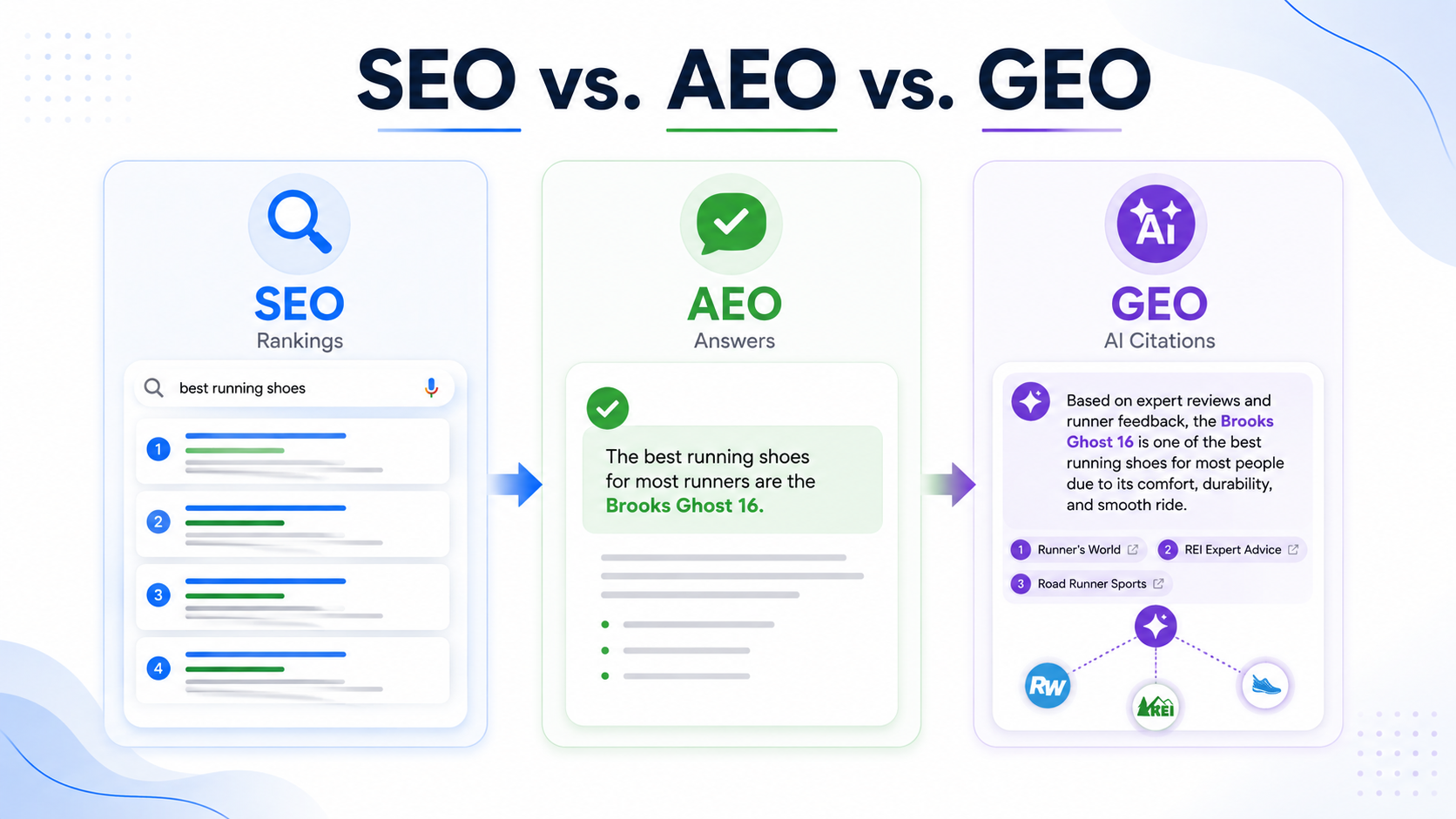

SEO vs AEO vs GEO

How to Capture Leads Even Without the Click


The path to conversion has changed. These are the strategies that help your brand stand out inside AI-generated answers.

1. Optimize for AI Citations, Not Just Rankings

Answer engine optimization means structuring content so AI systems can extract and quote it.

  • Open every page with a two to three sentence direct answer.
  • Use question-based headings that mirror how people actually ask.
  • Keep each paragraph self-contained, one idea at a time.

Businesses cited in AI Overviews earn 35 percent more organic clicks and convert visitors at four to nine times higher rates.

2. Deploy Structured Data Aggressively

Structured data for AI visibility is now table stakes. Schema markup for FAQ, Product, and Organization tells engines what your content covers and who stands behind it.

3. Publish Proprietary Data AI Must Credit

Generative engine optimization rewards content that cannot be paraphrased away. Original surveys, benchmarks, and case-study data force AI systems to name their source, and that is the core of LLM search optimization.

4. Make the SERP Itself Convert

SERP feature optimization means treating the results page like a landing page: a complete Google Business Profile, titles written as micro-ads, and a claimed knowledge panel. A user who never clicks can still remember you and convert later.

5. Build Direct-Capture Channels

Newsletters, LinkedIn, webinars, and communities create demand paths AI answers cannot intercept. A buyer who sees your brand in an AI answer and again in their inbox is already warm before the sales call.

6. Track New Metrics

The 2026 organic traffic decline is structural, not a penalty. Measure AI citation frequency, branded search volume, SERP impressions, and assisted conversions as part of an AI SEO strategy for lead generation.

How to Measure Success in a Zero-Click World

Every AI mention puts your brand in front of a customer. Over time, brand visibility without clicks builds the familiarity that turns into qualified traffic. Track these eight KPIs:

  • AI Overview Visibility: how often your content appears in AI summaries 
  • Featured Snippet Ownership: priority keywords held in an answer box 
  • Citation Frequency: how often ChatGPT, Perplexity, and Gemini name your brand
  • Branded Search Volume: growth in searches for your company name
  • Share of Voice: presence versus named competitors
  • Assisted Conversions: leads traced to an earlier AI mention
  • Local Pack Visibility: presence in map and business panel results 
  • Search Console Trends: impressions versus click-through rate, to tell a real ranking drop apart from zero-click behavior

If branded searches rise while organic clicks fall, the strategy is working.

The Future of Search: From Rankings to Recommendations

Search is no longer only about ranking first. Customers increasingly use AI to compare options, evaluate businesses, and make purchase decisions without visiting several websites.

For Moksh Digital, that changes the goal from achieving higher rankings to helping brands become credible recommendations inside AI-generated answers.

  • Create Original Insights: Publish original data, expertise, and perspectives that competitors cannot easily replicate.
  • Build for AI Understanding: Structure content and use schema so AI systems can accurately understand your brand, services, and expertise.
  • Strengthen Brand Authority: Demonstrate consistent expertise across your website and credible third-party sources.
  • Track AI Visibility: Monitor how often your brand appears in AI-generated answers and recommendations, alongside traditional rankings.
  • Focus on Recommendations: Build the authority needed to become a trusted source that AI systems can reference when customers are making decisions.
  • Moksh Digital’s perspective: Brands that adapt to recommendation-driven search now can build an advantage as search evolves beyond ranked results.

Moksh Digital’s perspective: brands that adapt to recommendation-driven search now can build an advantage as search evolves beyond ranked results.

Conclusion

Zero-click searches are not a passing trend—they represent a fundamental shift in how buyers discover, evaluate, and choose businesses. Today’s winning brands are those engineered for AI engines to read, extract, and credit, backed by direct channels that drive results even without a click.

Moksh Digital guides organizations through this transition across SEO, AEO, and GEO. We restructure your content to capture AI citations, elevate brand signals, and create dependable lead paths that deliver value when users don’t click through.

Schedule a GEO Audit with Moksh Digital.

In this article
Outsourcing IT
Need a stronger MSP partner?

Talk to Moksh Tech about dedicated engineers, 24/7 NOC, and white-label support built exclusively for MSPs.

Industry Pioneer
Mick Shah
CEO & Founder, Moksh Group

Bhaumik Shah is the CEO and Founder of Moksh Group and one of the MSP industry’s most forward-thinking voices. With more than 25 years of experience in managed services, he has spent his career at the intersection of technology, operations, and business growth.

Today, he leads an AI innovation firm with a singular focus: helping MSPs move beyond break-fix and reactive support to become Managed Intelligence Providers (MIPs)—businesses that leverage AI to deliver proactive, scalable, and future-ready client outcomes. His work is shaping what the next generation of managed services looks like.

Related articles